In the world of manufacturing, the choice of a machining method can significantly impact production quality and efficiency. Renowned industry expert Dr. Emily Chen states, "Selecting the right machining method is crucial when dealing with complex parts." This statement underscores the importance of careful evaluation in a field where precision is paramount.
Many manufacturers face the question of which machining method is best for complex parts. Various methods, including CNC machining, EDM, and 3D printing, offer unique advantages. Each has its own set of challenges, such as cost and time efficiency. For example, while CNC machining provides high precision, it may not be the best choice for intricate designs.
The best approach often incorporates multiple methodologies to achieve the desired outcome. However, the landscape is constantly evolving, and staying updated is essential. Continuous innovation can lead to better solutions, but it also necessitates ongoing learning and adaptation. As the industry progresses, the question of which machining method is best for complex parts remains a crucial topic for discussion among professionals.
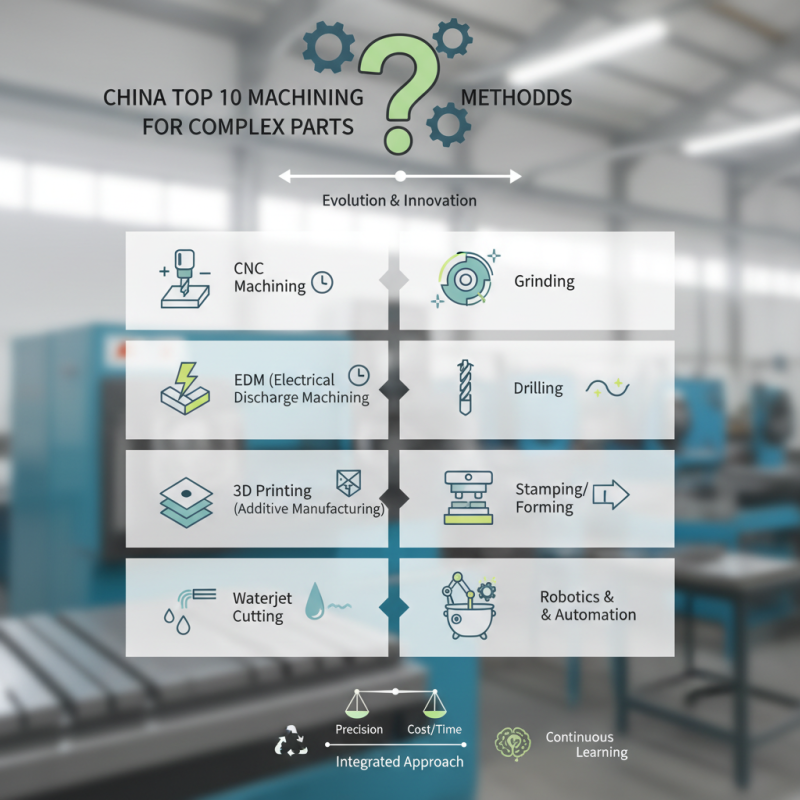
China has become a leader in machining complex parts. Various methods are employed to meet the demands of different industries. Each technique has its unique advantages and challenges, shaping the landscape of manufacturing.
CNC (Computer Numerical Control) machining is widely used. It offers precision and efficiency. However, the initial setup can be time-consuming and costly. Wire EDM (Electrical Discharge Machining) provides intricate designs but has limitations regarding speed and material types. Manufacturers often find themselves weighing the trade-offs between time and detail.
3D printing is gaining popularity too. It allows for rapid prototyping and customization. Yet, it may not always deliver the strength needed for final products. Every method has flaws and requires careful consideration.
Balancing cost, speed, and quality remains a constant challenge for manufacturers in China. Each project demands a tailored approach, reflecting the complex nature of modern machining.
Machining methods for complex parts have varying advantages and disadvantages. For instance,
CNC milling offers high precision, making it ideal for intricate designs.
According to the International Journal of Advanced Manufacturing Technology, CNC milling can achieve
tolerances as tight as ±0.01 mm. However, this method can be
expensive due to high initial setup costs and equipment maintenance.
Another notable technique is electrical discharge machining (EDM).
It excels at creating complex geometries in hard materials. The precision of EDM can reach
0.001 mm. Yet, it has its drawbacks. The process is slower and
can generate higher operational costs. A report by the Society of Manufacturing Engineers suggests
that while EDM can produce high-quality finishes, its slow speed may not
be ideal for large production runs.
Laser cutting stands out for its versatility. It can handle various
materials and thicknesses. However, it may not be the best for thicker materials, where plasma or
water jet cutting might be more effective. Each method requires careful consideration of material
properties and desired tolerances. Thus, manufacturers must assess their needs against the strengths
and weaknesses of these techniques.
Selecting the best machining method for complex parts entails careful consideration of several criteria. Factors such as material type, part geometry, and production volume all play a critical role. Understanding the intricacies of these criteria is essential for achieving the desired results.
Material properties influence the choice of machining methods. For instance, harder materials demand techniques that offer high precision and durability. Complex geometries may require advanced techniques like multi-axis machining. Evaluate the production volume too; methods differ in efficiency for low or high volume tasks.
Tips for selection: Test different methods on small batches. This gives insight into effectiveness without large investments. Additionally, consider the sustainability of the method. Energy efficiency and waste generation should guide your decision. Reflecting on past projects can highlight areas for improvement. Did the chosen method meet expectations? Revisiting these questions helps refine your approach.
When evaluating machining methods, examining successful case studies can illuminate their effectiveness. For instance, precision machining has been vital in aerospace applications. Complex components must meet strict specifications. Manufacturers often use CNC machines for consistent accuracy.
Another illustrative example is additive manufacturing in medical device production. This method allows customization for patient-specific implants. Based on real needs, engineers adapt materials and designs efficiently. However, challenges arise in material properties. Not all additives provide strength or durability.
Tips: Understand your project's unique requirements before choosing a method. Material selection can significantly impact performance. Testing prototypes may reveal potential issues early in development. Engage with experts to optimize your approach. Balancing efficiency and quality is crucial in complex machining.
In recent years, machining methods in China have undergone significant transformation. With the rise of complex parts manufacturing, new technologies are emerging to meet industry demands. Additive manufacturing and hybrid machining are leading the way. These methods offer precision and flexibility, allowing for intricate designs that were previously difficult to achieve.
The emphasis on efficiency and sustainability is shaping the future of machining in China. Advanced automation and artificial intelligence are streamlining processes. Yet, challenges remain. Skilled labor shortages continue to impact production capabilities. Furthermore, not every company can afford the latest technology. This creates a disparity in the market.
Sustainability is not just a trend; it’s a necessity. As industries strive for greener solutions, eco-friendly machining methods gain traction. Investing in renewable resources and reducing waste are becoming essential practices. The path forward is not without hurdles, but the direction is clear: innovation and adaptability will define the future of machining in China.
: CNC machining uses computer software for precise and efficient manufacturing. It is popular for complex parts.
The setup can be time-consuming and expensive. Maintenance also adds to ongoing costs.
Wire EDM uses electrical discharges to cut materials into intricate shapes. It excels in detail but is slower.
Limitations include slower speeds and restricted material types. Costs can escalate for large projects.
3D printing allows fast prototyping and customization. It's useful for unique designs and experiments.
Strength can be a concern for final products. It may not meet all requirements for durability.
CNC milling delivers high precision, with tolerances of ±0.01 mm. It's ideal for detailed projects.
High initial setup costs and ongoing maintenance can be a burden for manufacturers.
Laser cutting is versatile for various materials but struggles with very thick materials.
They must weigh cost, speed, quality, and material properties to find the best machining technique.
In the rapidly evolving landscape of manufacturing in China, selecting the best machining method for complex parts is crucial for optimizing production efficiency and quality. The article explores an overview of various machining techniques, highlighting the top 10 methods alongside their respective advantages and disadvantages. A thorough examination of criteria for selecting the most suitable machining method provides valuable insights for manufacturers facing complex production challenges.
Additionally, the article features case studies showcasing successful applications of various machining methods, emphasizing their effectiveness in real-world scenarios. As the industry moves forward, future trends in machining for complex parts indicate an increasing focus on innovation and technology integration. Ultimately, determining which machining method is best for complex parts involves careful consideration of these factors to ensure optimal manufacturing outcomes.

Nuplanta CNC