Machining cost is rarely determined by the machine’s hourly rate alone. A small aluminum bracket may look simple, yet its price can rise with tight tolerances, extra setups, slow cutting, or costly finishing. So, which factors influence machining cost? The answer usually starts with material, part geometry, production volume, and the time needed to make each feature. Tool wear matters too. A hard alloy can dull cutters faster, while deep pockets may require cautious passes and careful chip removal.
Manufacturing engineer Shigeo Shingo is widely associated with this warning: “The most dangerous kind of waste is the waste we do not recognize.” That idea applies on the shop floor. A fixture change that takes twenty minutes, or a surface finish that needs another operation, can quietly add cost to every batch. These details are easy to miss in a drawing review. They are not always obvious from a quote, either. This guide examines seven practical cost drivers, from material choice and tolerances to setup time and inspection. It also considers how design changes and order size affect the final price. There is no universal cheapest process. A faster estimate is not always a better one. And even careful cost models can miss surprises. The goal is to help buyers and engineers ask clearer questions before production begins.
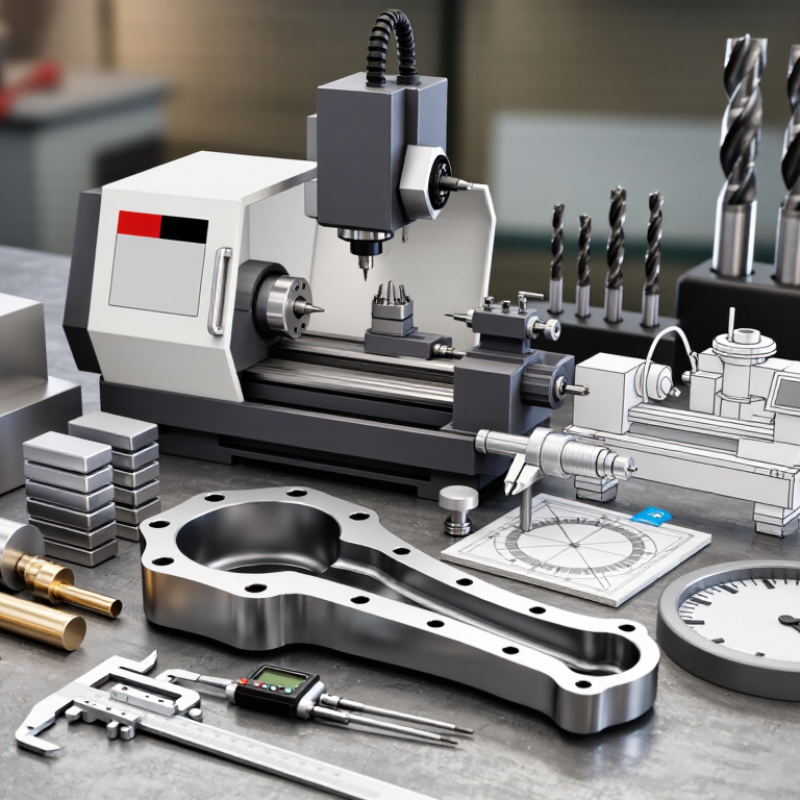
Material Selection and Its Effect on Machining Costs
Material choice often controls more than raw stock price. It affects cutting speed, tool life, cycle time, scrap, and finishing work. The USGS Mineral Commodity Summaries 2024 reported average 2023 prices near $1.05 per pound for aluminum and $3.85 for copper. This gap matters before machining begins. However, a cheaper alloy can become expensive when it machines poorly.
Tip 1: Compare total cost, not price per kilogram. Tip 2: Check hardness and tensile strength. Hard materials usually require slower cutting and stronger tooling. Tip 3: Review machinability data from the material supplier. Ratings can differ between similar alloys. Tip 4: Match stock size closely to the finished part. Excess material creates more chips, time, and waste.
The U.S. Department of Energy’s manufacturing assessments commonly place material costs near 50–60% of total manufacturing cost. That figure is a useful warning, not a universal rule. Tip 5: Ask whether heat treatment is essential. It may improve performance but add transport and inspection steps. Tip 6: Consider scrap value and recycling requirements. Tip 7: Test a small batch before fixing the production route. A shop may estimate aluminum as easy, yet thin walls can deform during clamping. That detail is easy to miss. Recheck the design, material grade, and tolerance together.
| Material option | Relative raw-material cost per kg | Indicative machining time vs. 6061-T6 aluminum | Machining characteristics | How material choice can affect total cost | Cost-conscious selection tip |
|---|---|---|---|---|---|
| 6061-T6 aluminum | Baseline (1×) | Baseline (1×) | Generally machines readily, has good chip formation, and is widely available in common stock forms. | Often a practical baseline for comparing material and cutting costs. Part geometry, tolerances, and finishing still affect the final price. | Consider it when its strength, corrosion resistance, and service-temperature limits meet the design requirements. |
| 7075-T6 aluminum | About 1.5–3× | About 1.1–1.5× | High strength-to-weight ratio; generally machinable, though alloy condition and part geometry influence tool wear and cycle time. | Higher stock cost than 6061 can outweigh modest differences in machining time, especially when much of the billet becomes scrap. | Use when the added strength is functionally needed; avoid specifying it solely as a general-purpose aluminum upgrade. |
| Low-carbon steel | About 0.5–1.5× | About 1.5–2.5× | Typically tougher to cut than aluminum and may need slower cutting conditions; corrosion protection may be required. | Lower stock cost may be offset by longer machining time, added tool use, and protective finishing. | Compare the complete process cost, including any coating or corrosion-control requirements. |
| 304 stainless steel | About 2–4× | About 2–4× | Work-hardens during cutting and conducts heat less effectively than aluminum, so tooling and cutting parameters matter. | Higher material cost and slower machining can both raise the part price, particularly for deep pockets or tight tolerances. | Choose it where its corrosion resistance and service properties are required; use a less costly suitable alloy when they are not. |
| 316 stainless steel | About 2.5–5× | About 2.5–4.5× | Similar machining challenges to 304; its added corrosion resistance can be valuable in chloride-rich or demanding environments. | Premium stock cost and machining effort can increase cost without adding value in mild service conditions. | Reserve it for applications where its corrosion-resistance advantages are relevant to the operating environment. |
| Ti-6Al-4V titanium | About 10–25× | About 4–8× | High strength, low thermal conductivity, and heat at the cutting zone require careful tooling and process control. | Both costly stock and extended machining can make it substantially more expensive; low material utilization can further increase cost. | Specify titanium when its strength-to-weight ratio, temperature performance, or corrosion behavior is necessary for the design. |
| PEEK (unfilled) | About 15–40× | About 1–2× | Can machine relatively quickly, but heat management, workholding, and dimensional stability need attention. | High stock cost may dominate even when cutting time is moderate. Filled grades can behave differently and may increase tool wear. | Confirm that the polymer’s temperature, chemical, and mechanical properties are needed before selecting it over lower-cost plastics. |
How to read these estimates: Relative cost and machining-time ranges are indicative planning values, not quotations or fixed industry standards. They compare common stock and similar part complexity against 6061-T6 aluminum; actual results vary with supplier, stock form, part size, tolerances, tooling, batch quantity, and finishing. Material price per kg alone does not determine part cost—buy-to-fly ratio and scrap also matter.
Raw material price is only one part of the estimate. Difficult materials may require slower cutting, stronger tools, and longer finishing. Cheap stock can become expensive. Compare the complete process, not only price per kilogram.
Hard materials usually need slower speeds and more durable tooling. Cutting may take longer, while tool replacement becomes more frequent. Check hardness, strength, and supplier machinability data together.
Oversized stock creates extra chips, cutting time, and waste. A closer starting size can reduce machining hours. However, leave enough material for clamping and final finishing.
A simple bracket may suit a three-axis mill. A contoured part might need fewer repositioning steps on a multi-axis machine. Compare setup, fixturing, programming, cycle time, and hourly rates.
Material, toolpath, feed, speed, and inspection all affect cycle time. Tool changes also consume minutes. A spreadsheet can miss them. Trial-run results should challenge the original estimate.
Worn cutting edges can cause dimensional drift and rough surfaces. They may also increase inspection and rejection costs. If wear appears early, review cutting conditions instead of accepting the allowance blindly.
Programming, workholding, alignment, and first-piece inspection still require time. A small batch spreads those costs across fewer parts. Setup matters. The machine may spend longer preparing than cutting.
The quote should separate material, setup, run time, tooling, inspection, and finishing. It should mention expected scrap and possible heat-treatment steps. If everything appears as one number, ask questions. The estimate may still be wrong.
Understanding which factors influence machining cost is essential for planning an efficient and competitive manufacturing project. Material selection plays a major role because difficult-to-cut, expensive, or highly abrasive materials may require specialized tools and slower cutting conditions. Part geometry, complexity, and tolerance requirements also affect cost, since intricate shapes and tight tolerances usually demand more programming, advanced equipment, additional operations, and careful verification.
Machine selection influences cutting time, energy use, and tool wear. Production volume and setup requirements are equally important: small batches may carry higher setup costs per part, while larger volumes can spread these expenses more effectively. Labor requirements, including programming, loading, and process supervision, should also be considered. Finally, surface finishing, quality inspection, packaging, and delivery schedules can add time and expense. Evaluating all these elements together helps manufacturers estimate costs accurately, identify opportunities for improvement, and choose a practical balance between quality, speed, and budget.

 Nuplanta CNC